Calvert County Health Department
- Adult Evaluation Reviews (AERS)
- Breast and Cervical Cancer Program
- Destination Wellness
- Developmental Disabilities Program
- Health Insurance Programs
- Home and Community-Based Services
- Maternal and Child Health
- Medical Assistance Program
- Medical Assistance Transportation Program
- Reproductive Health
- Reproductive Health Clinic Schedule
- Child Safety Seats
- Colorectal Cancer Awareness & Screening
- Diabetes and Prediabetes
- E-Cigarettes and Vaping
- Heart Health
- Injury Prevention
- Oral Cancer Prevention
- Poison Prevention
- Responsible Tobacco Retailer Program
- Skin Cancer Awareness
- Quit Tobacco Program
- Stroke Awareness
- Quit Tobacco for Pregnant Women
- Tobacco Use Prevention







Cannabis
About the Program
Calvert County Health Department’s Cannabis Program has several main goals:
- Preventing the initiation of cannabis use, particularly for youth
- Educating Calvert County residents on the risks of cannabis use
- Promoting substance use counseling and treatment
- Collecting data on public health effects of adult-use cannabis legalization
What is cannabis?
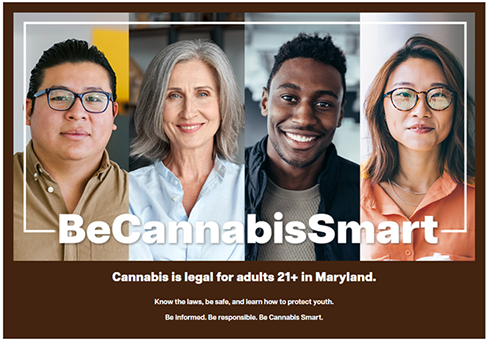
Cannabis, more commonly referred to as marijuana, weed, or pot, is a substance that can cause psychoactive (mind-altering) effects. As of July 1, 2023, adults ages 21 and over in the state of Maryland can legally use cannabis. Cannabis currently remains illegal under federal law.
What is THC? What about CBD?
Cannabis has two main chemicals that affect the brain in different ways:
THC (tetrahydrocannabinol) provides the “high” feeling. How “high” depends on many factors, including the type of product and how much THC is consumed. Effects vary from person-to-person, and someone may feel differently each time they consume. Consuming products with higher amounts or percentages of THC, such as vapes or concentrates, increases the risk for unwanted side effects and cannabis use disorder.
CBD (cannabidiol) does not provide a “high” but can have other effects on the body and mind.
How much cannabis can adults legally possess?
Adults can legally possess up to what is called the “personal use amount.” This amount equates to:
- 1.5 ounces of flower (pre-packaged flower, pre-rolls)
- 12 grams of concentrates (vapes, wax, shatter, butter/budder, resin)
- 750 mg of THC (edible gummies, chocolates, beverages, capsules, tinctures)
- 2 plants or seedlings (up to two plants per household, indoors, out of public view)
By comparison, the “civil use amount” is:
- Usable cannabis that exceeds 1.5 ounces but does not exceed 2.5 ounces, cannabis vape products that exceed 12 grams but do not exceed 20 grams; or
- Cannabis products containing THC that exceed 750 milligrams but do not exceed 1,250 milligrams.
Possession of the civil use amount is a civil offense punishable by a fine not exceeding $250. Possession of more than the civil use amount of cannabis can lead to criminal penalties.
How does cannabis affect the body?
Cannabis can have a variety of physical and mental effects on the body, including:
- Trouble thinking, remembering, and problem solving
- Pain relief for some conditions
- Seeing or hearing things that aren’t real (especially with higher THC doses)
- Reduced nausea/vomiting related to chemotherapy
- Mood swings
- Dry mouth, dizziness, hunger, and/or bloodshot eyes
- Slowed movement and coordination
- Feeling like time is moving slower OR faster
- Feeling relaxed OR feeling paranoid
- Increased OR decreased anxiety
- Faster heartbeat OR lower blood pressure
How can cannabis affect mental health?
It is possible for cannabis to harm (not help) mental health. Cannabis use has been linked to anxiety, depression, and schizophrenia (a type of mental illness where people might see or hear things that are not really there). Research suggests that mental health disorders may develop or worsen from daily/near daily cannabis use, higher THC cannabis use, or regular cannabis use in teens/young adults.
What should youth know about cannabis?
It is especially important for young people to know that “legal” does not mean “safe.” Cannabis use poses added risks for youth and young adults because THC acts directly on the brain, which continues to develop until about age 25. Regular cannabis use during teen years and early adulthood may harm memory, learning, and attention — and effects may be long term.
Is cannabis safe for women who are pregnant or breastfeeding?
There is no amount of cannabis use that is known to be safe in pregnancy or while breastfeeding. If you use cannabis, you may be putting your health and your baby’s health at risk. This includes smoking, eating, and vaping cannabis.
Tetrahydrocannabinol or THC — the part of cannabis that makes you feel high — passes to your baby during pregnancy and breastfeeding. More research is needed, but babies exposed to THC may have problems feeding and long-term problems paying attention and learning.
THC can stay in breast milk for several weeks. “Pumping and Dumping” does not work. Cannabis can also impair your judgment, alertness, and reaction time as a parent. These skills are needed to safely care for your child.
Where can cannabis be used?
Generally, it is legal to smoke cannabis in private homes and on private property. For individuals who rent, additional restrictions may apply per your lease or HOA agreement.
Smoking cannabis is prohibited in all indoor and outdoor public spaces including parks, event venues, bars, restaurants, streets, and sidewalks.
Individuals are also subject to workplace policies on cannabis use.
Where can cannabis be purchased?
Cannabis products can be purchased from a licensed dispensary. For a current list of licensed dispensaries, please refer to the Maryland Cannabis Administration’s Dispensary Locator. To purchase cannabis, individuals must be 21 years of age or older and possess a valid government-issued photo ID.
THC products sold in licensed dispensaries have strict state oversight on processing, lab testing, packaging, and labeling. Products sold outside of licensed dispensaries are not regulated, meaning their contents have not been state-tested or inspected prior to sale.
As of July 1, 2025, a 12% sales tax is applied on cannabis. These taxes are used for various programs, including covering operating costs of the Maryland Cannabis Administration, funding community-based organizations that serve areas most impacted by enforcement of cannabis prohibition, and funding initiatives to address the health effects associated with legalization of adult-use cannabis.
Is it safe to drive under the influence of cannabis?
It is NOT safe to drive under the influence of cannabis. Cannabis can slow reaction time, coordination, and decrease a person’s ability to concentrate and make decisions. Someone under the influence of cannabis may have reduced awareness of time and distance as well as difficulty staying in their lane.
Intoxicating effects of cannabis may last for longer than expected. After cannabis use, wait at least 6 hours to drive — and keep in mind that effects from edibles can be delayed several hours or more.
Driving while impaired by cannabis is illegal in Maryland, with the same penalties as driving drunk.
Who enforces cannabis regulations?
The Alcohol, Tobacco, and Cannabis Commission (ATCC) is responsible for enforcing illegal or unlicensed sales of cannabis in Maryland, including sales to individuals under 21 years old. To report a violation or file a complaint, you can fill out this form.
The Maryland Cannabis Administration (MCA) is responsible for Maryland’s legal cannabis market. To report an adverse health reaction related to cannabis, or to submit a complaint about a cannabis business or product, you can fill out this form.
Helplines
Medical Attention: 911
Mental Health Support: 988 (call or text)
Maryland Poison Center: 800-222-1222
Pet Poison Hotline: 855-764-7661 (fee applies)
